closed loop lambda regulator
Lambda controller type
Specifies which lambda controller type to use, or completely disables lambda.
Wide band controller uses lambda target table as target for the closed loop regulator.
Narrow bands target is always lambda 1 since sensor has a limited output signal.
lambda feedback conditions
Min CLT
Specifies the lowest coolant temperature to activate closed loop lambda regulator.
Note: Some external wide band controllers might not work good in cold conditions, please be aware when adjusting this setting. Narrow band sensors should not be controlling fuel on cold conditions.
Min run time
Specifies minimum engine run time before activation of closed loop lambda regulator can be done.
Transient deactivation
rate type
Specifies which transient deactivation mode should be used.
•change per cycle (old) - The transient deactivation is from change per cycle.
•rate/sec (recommended) - The transient deactivation is based on changes per second (rate/second) and is the recommended setting.
Max TPS delta/rate
Specifies TPS delta/rate at which the closed loop lambda controller is deactivated.
The lambda regulator must be turned off for a short period during acceleration and then reactivated.
Max MAP delta/rate
Specifies how much change in the MAP sensor to deactivate closed loop lambda regulator.
The lambda regulator must be turned of for a short period of time during acceleration and then reactivated.
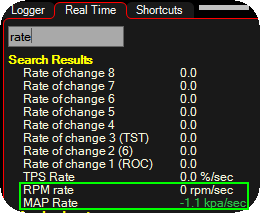
The RealTime Data values used to set the transient deactivation.
reactivation delay
The reactivation delay temporarily pauses lambda control after events that can disturb the lambda reading. This gives the lambda sensor and engine time to stabilize before closed-loop control resumes.
Note: When lambda control is deactivated, the current lambda correction value(s) are frozen and held. They are not reset to 0%.
reactivation delay
Select how the reactivation delay is determined.
•Fixed - Uses the fixed time values configured below.
•table - Uses dynamic tables, allowing 4D conditions to determine the delay time.
Deactivation type, throttle changes
Select how lambda correction behaves during throttle changes:
•off - Disables lambda correction completely.
•hold - Freezes the current lambda correction value until lambda correction is reactivated.
reactivation delay, throttle changes
Specifies the delay applied after transient deactivation, such as rapid throttle or MAP changes. This prevents temporary fueling deviations from causing unnecessary lambda corrections during quick driver inputs.
deactivation type, fuel/ign cuts
Select how lambda correction behaves during throttle any ign/fuel cuts:
•off - Disables lambda correction completely.
•hold - Freezes the current lambda correction value until lambda correction is reactivated.
reactivation delay, fuel/ign cuts
Specifies the delay applied after events that significantly disturb the lambda sensor reading, including: Fuel cuts. Ignition cuts, Launch control activation, Overrun fuel cut activation and other functions that heavily upset fueling or exhaust oxygen content
The delay allows the lambda sensor reading to recover before closed-loop lambda control is re-enabled.
Tip: If deceleration causes unwanted lambda corrections, consider using the Overrun Fuel Cut function instead of relying on throttle transients. This will use the Fuel/Ign Cut reactivation delay and typically results in more stable lambda control.
Lambda regulator
Controller frequency Mode
Specifies how many times per second fuel should be adjusted.
•rpm based - Uses a a fixed table list.
•user table - Uses a dynamic table that can be used with 4D.
Step size
Specifies how fast fuel should be adjusted when using narrow band sensor.
Regulator gain
Specifies how fast fuel changes should be done when using wide band sensor.
MAx negative correction
Specifies maximum negative fuel corrections in % to be applied.
Max positive correction
Specifies maximum positive fuel adjustments that can be applied.
Note: Please be caution to not use to much negative/positive compensation during high load of engine, in cause of sensor failure. Do not use compensations in high load when using a narrow band sensor.
Video example

MaxxECU Video Academy - Closed loop lambda
Adjusting target lambda value from temperature
The extra Extra fuel tables could be used to change the lambda target table depending on for example coolant temperature or any other available data value.